

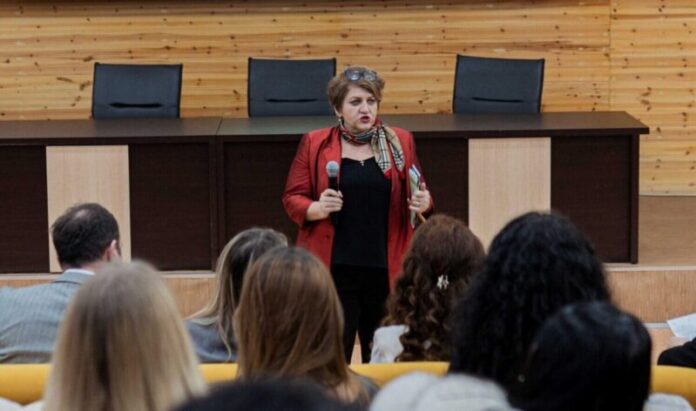
Valentina Ndou: Diaspora4Innovation bridges Universities and European Projects

E martë, 17 Nëntor, 2026

Valentina Ndou: Diaspora4Innovation bridges Universities and European Projects

The “Diaspora4Innovation” programme, implemented by GERMIN, demonstrated that collaboration is measured not only by academic exchange and the knowledge diaspora professionals share with Albanian students, but also by the opportunities that emerge after a project comes to an end.

In the case of the collaboration between Albanian academic Valentina Ndou, Associate Professor at the University of Salento, and Professor Blerta Dragusha of the University of Shkodra, the initiative served as a starting point for research collaboration and the preparation of a joint proposal for the European Erasmus+ Capacity Building programme.

Through this example, Diaspora4Innovation demonstrated that connections between academics in the diaspora and Albanian universities can extend beyond a single lecture or a time-limited activity, laying the groundwork for new projects, knowledge exchange and the long-term strengthening of university capacities.

In this interview with Gazeta Diaspora Shqiptare, Valentina Ndou discusses how she became involved in Diaspora4Innovation, the changes she introduced to teaching by connecting students with real-world challenges in the financial sector, and how the collaboration paved the way for new European projects. She also reflects on the role of the academic diaspora in developing Albanian universities and the importance of building partnerships that continue to deliver results long after a project has ended.

Through a series of interviews, Gazeta Diaspora Shqiptare will profile Albanian academics involved in the Diaspora4Innovation programme, exploring their professional journeys, international experience and contributions to the development of education and scientific research in Albania.
You are part of the academic diaspora and have worked for years in innovation, entrepreneurship and digital transformation. What motivated you to join Diaspora4Innovation and collaborate specifically with the University of Shkodra?

Like many professionals and academics, I use LinkedIn extensively to keep up with initiatives, projects and collaboration opportunities. It was there that I came across GERMIN’s initiative and the Diaspora4Innovation project by chance. I read about it carefully, learned more about its objectives and felt it offered a concrete opportunity to contribute.

Collaboration with the Albanian academic community has always been very important to me. Although I have lived and worked in Italy for many years, I consider building bridges between Albanian and European universities, transferring experience and creating new opportunities for students and colleagues to be almost a personal and professional mission.

Choosing Shkodra was no coincidence. Attention, projects and opportunities are often concentrated in Tirana, whereas I believe it is equally important to create opportunities for universities in other cities. Shkodra is my hometown, and the University of Shkodra is where I graduated and received my initial academic training. Returning in a different capacity to contribute to the institution that laid the foundations for my professional journey had a special meaning for me.

Another very important factor was the opportunity to work with Professor Blerta Dragusha. Blerta and I share not only academic interests but also part of our personal and professional journeys, having studied together and maintained contact over the years. This made the collaboration feel very natural, grounded in trust, a shared vision and a desire to create something tangible for students.

Together with Professor Blerta Dragusha, you redesigned the Corporate Finance course, incorporating entrepreneurship, innovation, design thinking and artificial intelligence. What was missing from traditional teaching methods, and what did you aim to change?

I would not say that traditional teaching methods necessarily lack theoretical knowledge. The problem is that theoretical knowledge alone is no longer sufficient today.

The labour market is changing rapidly, particularly in the financial sector. Artificial intelligence, digital transformation, new business models, fintech and automation are changing the way banks and companies operate.

Our aim, therefore, was to ensure that students did not simply learn about finance, but also understood how financial knowledge could be applied to create innovation and value.

For this reason, we incorporated topics such as entrepreneurship, entrepreneurial competencies, the Business Model Canvas, design thinking, innovation management and the use of artificial intelligence in finance.

The most important change, however, was methodological. We wanted students to move from a largely passive role, in which they listen and reproduce knowledge, to an active one: identifying a problem, working in teams, engaging in dialogue with companies, developing a solution, structuring it and ultimately presenting and defending it before experts.

In other words, we aimed to change not only what students learn, but also how they learn.
One of the project’s key components was the Open Innovation Challenge, in which students worked directly with banks and industry professionals. What did this approach bring compared with a traditional university course?

The Open Innovation Challenge was perhaps one of the most important elements of the entire experience because it created a tangible bridge between the university and the real world.

In a traditional course, professors explain existing problems, models and solutions to students. In this case, students engaged directly with real-world problems and challenges facing the financial sector.

They worked on topics including digital transformation, banks’ operational efficiency, customer relations, financial inclusion, the use of artificial intelligence, fraud detection, alternative credit scoring, financial literacy, compliance, remittances and financial management for small and medium-sized enterprises (SMEs).

The involvement of banks and industry professionals also significantly changed the students’ perceptions. It was no longer simply an assignment to earn a grade. They knew that, at the end of the process, they would present their ideas to people who deal with these challenges every day.

This creates a different level of responsibility, motivation and engagement.

At the same time, students begin to understand that real-world problems are almost always multidisciplinary. Developing an effective financial solution requires an understanding of technology, customers, business models, costs, risk and impact.

Working with students, which ideas or solutions impressed you most, and what did they reveal to you about the potential of young Albanians?

What impressed me most was the students’ ability to identify very concrete problems in their own environment and transform them into business ideas or technological solutions.

The 11 groups that took part in the project developed a range of proposals involving the use of artificial intelligence in the financial sector. These included ideas for improving banks’ operational efficiency and customer-service chatbots, as well as solutions aimed at expanding financial inclusion for more vulnerable groups, such as older people, people with disabilities and those with more limited access to financial services.

These ideas impressed me in particular because they showed that students did not view technology merely as a tool for cutting costs or automating processes, but also as a means of generating social impact.

This experience confirmed something I have always believed: young Albanians have enormous potential. They are creative, adapt quickly and are very open to new technologies.

What is often missing is not talent, but the ecosystem: opportunities, mentoring, contact with companies, international exposure and spaces where young people can experiment.

When these conditions are in place, the results can be very promising.

You have worked for years in innovation, digital transformation and new business models. How important is it for these fields to translate into practical skills for students rather than remain confined to academic research?

It is essential.

Universities cannot limit themselves to producing and transmitting knowledge. They must also be able to transform that knowledge into competencies.

We can publish numerous studies on artificial intelligence, digital transformation or entrepreneurship, but if students graduate without knowing how to use that knowledge to solve a concrete problem, we have failed to fulfil an important part of our mission.

For me, competencies develop at the intersection of knowledge, application and experience.

Students need to understand a concept, but they must then be able to put it into practice: work in teams, analyse complex problems, use technology, develop a business model, present an idea, engage with a company and make decisions under conditions of uncertainty.

These are precisely the skills they will need in the future.

Your collaboration through the Diaspora4Innovation programme extended beyond teaching to include research cooperation and the preparation of a joint Erasmus+ proposal. How important is it for connections between academics in the diaspora and Albanian universities to continue after a project ends?

For me, this is perhaps the most important point.

A project has a beginning and an end. A successful academic collaboration, however, should continue beyond the life of the project.

In our case, the experience began with teaching but soon led to research collaboration and ideas for new projects. We also worked together to prepare an Erasmus+ Capacity Building proposal with an international consortium, with the aim of strengthening research, innovation and knowledge-transfer capacities at universities across the Western Balkans.

This is the model I believe we should pursue.

The diaspora should not be invited merely to deliver a lecture or seminar. Real value is created by building long-term relationships: joint projects, publications, mobility opportunities, co-supervision of students, joint programmes, international networks and opportunities for young people.

This approach builds institutional capacity rather than resulting in just a one-off individual activity.

Based on your experience, what needs to change in the way Albanian universities collaborate with the private sector and industry?

I believe we need to move from occasional collaboration to structured partnerships.

Universities often invite companies to take part in a seminar, conference or event. That is positive, but it is not enough.

Companies should be more closely involved in the educational process itself: identifying the competencies required by the labour market, defining challenges for students, providing mentoring and internships, supporting laboratories and applied research projects, and contributing to the development of student theses.

At the same time, universities should not view industry merely as a source of funding. Universities have a great deal to offer industry: research, talent, analysis, technology and the capacity to experiment.

We need to build relationships based on the co-creation of value.

Beyond this project, what do you think the academic diaspora can bring to Albanian universities that is more difficult to develop within the domestic academic system alone?

The diaspora can contribute in several very important ways.

First, it brings experience from other academic systems and the opportunity to transfer practices that have proved effective at different universities.

Second, it provides international networks. An academic working outside Albania has contacts with universities, research centres, companies and various institutions. These networks can open doors to projects, mobility opportunities, publications and collaborations that might otherwise be more difficult to establish from scratch.

I also believe the diaspora can offer a particularly valuable hybrid perspective. We understand the Albanian context, while also being able to view it from the outside. This allows us to better understand both its challenges and its potential.

However, I do not believe the diaspora should come to tell the Albanian academic system “how things should be done”. It should come to collaborate, listen and co-create solutions with those who work within the system every day.

A more personal question: what connects you to Albania today, and what makes you believe it is worth investing your time and expertise in the development of academia and young people here?

Albania is part of my identity, and Shkodra, in particular, is a very important part of my personal history.

I grew up there, studied there and acquired the foundations that later enabled me to build my academic and professional career abroad.

For me, therefore, giving back the experience and knowledge I have gained over the years is a very natural process.

Working with young people is a particular source of motivation. When you see a student who is initially unsure of themselves and, a few months later, is able to develop a project, present an idea, engage in a discussion with a bank or imagine launching a start-up, you realise that investment in education has an impact that extends far beyond a single course.

Ultimately, a country’s development depends to a great extent on the opportunities we create for the next generation. If those of us who have had the opportunity to build international experience and networks can help, even in a small way, to create such opportunities, I believe it is absolutely worthwhile.

You have built your academic career in Italy. What has your journey as an immigrant seeking to integrate into the Italian academic world been like, and what have been the greatest challenges along the way?

It has been a long journey, built step by step.

When you enter a new academic system, you have to understand not only the language but also its institutional culture, working methods, evaluation criteria, professional networks and the dynamics of a highly competitive environment.

At the beginning, you have to prove yourself repeatedly. You need to establish credibility, build your professional network and consistently demonstrate the value of your work.

In academia, results do not come quickly. They require years of research, publications, teaching, projects and international relationships.

Naturally, being an immigrant brings an additional challenge: at the outset, you do not necessarily have the same social capital or the same networks as someone who has grown up and received their entire education within that system.

However, this experience has also taught me to be highly independent, seek out opportunities, build international networks and avoid limiting my work to a single institution or country.

How difficult has it been to establish your professional identity in a new society and find your place in a competitive academic system? Has your background been a challenge, an added value, or both?

I would say both.

At certain moments, your background can be a challenge, particularly at the beginning, when you have to integrate into a new system, understand its rules and establish your professional credibility.

Over time, however, I have come to realise that having an identity shaped by two cultures is also a tremendous asset.

Being Albanian and having built my career in Italy has allowed me to view many issues from different perspectives. It has made me more open to international collaboration, more sensitive to diversity and perhaps better equipped to build bridges between people, institutions and countries.

Today, I consider this dimension an important part of my professional identity.

I do not believe we have to choose between the country we come from and the country in which we have built our careers. We can belong professionally to both worlds, and it is precisely at the intersection of these two realities that something truly valuable can emerge.

For me, this is also the most compelling idea behind the academic diaspora: not simply the departure of knowledge from one country, but its circulation and the creation of bridges that bring it back in new forms.

 

Materialet e publikuara nga “Diaspora Shqiptare” janë të mbrojtura nga të drejtat e autorit. Rishpërndarja, riprodhimi, modifikimi apo përdorimi i tyre, i pjesshëm ose i plotë, pa lejen e shprehur të redaksisë, është i ndaluar dhe shkel ligjet mbi të drejtat e pronës intelektuale.

The “Diaspora4Innovation” programme, implemented by GERMIN, demonstrated that collaboration is measured not only by academic exchange and the knowledge diaspora professionals share with Albanian students, but also by the opportunities that emerge after a project comes to an end.

In the case of the collaboration between Albanian academic Valentina Ndou, Associate Professor at the University of Salento, and Professor Blerta Dragusha of the University of Shkodra, the initiative served as a starting point for research collaboration and the preparation of a joint proposal for the European Erasmus+ Capacity Building programme.

Through this example, Diaspora4Innovation demonstrated that connections between academics in the diaspora and Albanian universities can extend beyond a single lecture or a time-limited activity, laying the groundwork for new projects, knowledge exchange and the long-term strengthening of university capacities.

In this interview with Gazeta Diaspora Shqiptare, Valentina Ndou discusses how she became involved in Diaspora4Innovation, the changes she introduced to teaching by connecting students with real-world challenges in the financial sector, and how the collaboration paved the way for new European projects. She also reflects on the role of the academic diaspora in developing Albanian universities and the importance of building partnerships that continue to deliver results long after a project has ended.

Through a series of interviews, Gazeta Diaspora Shqiptare will profile Albanian academics involved in the Diaspora4Innovation programme, exploring their professional journeys, international experience and contributions to the development of education and scientific research in Albania.

You are part of the academic diaspora and have worked for years in innovation, entrepreneurship and digital transformation. What motivated you to join Diaspora4Innovation and collaborate specifically with the University of Shkodra?

Like many professionals and academics, I use LinkedIn extensively to keep up with initiatives, projects and collaboration opportunities. It was there that I came across GERMIN’s initiative and the Diaspora4Innovation project by chance. I read about it carefully, learned more about its objectives and felt it offered a concrete opportunity to contribute.

Collaboration with the Albanian academic community has always been very important to me. Although I have lived and worked in Italy for many years, I consider building bridges between Albanian and European universities, transferring experience and creating new opportunities for students and colleagues to be almost a personal and professional mission.

Choosing Shkodra was no coincidence. Attention, projects and opportunities are often concentrated in Tirana, whereas I believe it is equally important to create opportunities for universities in other cities. Shkodra is my hometown, and the University of Shkodra is where I graduated and received my initial academic training. Returning in a different capacity to contribute to the institution that laid the foundations for my professional journey had a special meaning for me.

Another very important factor was the opportunity to work with Professor Blerta Dragusha. Blerta and I share not only academic interests but also part of our personal and professional journeys, having studied together and maintained contact over the years. This made the collaboration feel very natural, grounded in trust, a shared vision and a desire to create something tangible for students.

Together with Professor Blerta Dragusha, you redesigned the Corporate Finance course, incorporating entrepreneurship, innovation, design thinking and artificial intelligence. What was missing from traditional teaching methods, and what did you aim to change?

I would not say that traditional teaching methods necessarily lack theoretical knowledge. The problem is that theoretical knowledge alone is no longer sufficient today.

The labour market is changing rapidly, particularly in the financial sector. Artificial intelligence, digital transformation, new business models, fintech and automation are changing the way banks and companies operate.

Our aim, therefore, was to ensure that students did not simply learn about finance, but also understood how financial knowledge could be applied to create innovation and value.

For this reason, we incorporated topics such as entrepreneurship, entrepreneurial competencies, the Business Model Canvas, design thinking, innovation management and the use of artificial intelligence in finance.

The most important change, however, was methodological. We wanted students to move from a largely passive role, in which they listen and reproduce knowledge, to an active one: identifying a problem, working in teams, engaging in dialogue with companies, developing a solution, structuring it and ultimately presenting and defending it before experts.

In other words, we aimed to change not only what students learn, but also how they learn.

One of the project’s key components was the Open Innovation Challenge, in which students worked directly with banks and industry professionals. What did this approach bring compared with a traditional university course?

The Open Innovation Challenge was perhaps one of the most important elements of the entire experience because it created a tangible bridge between the university and the real world.

In a traditional course, professors explain existing problems, models and solutions to students. In this case, students engaged directly with real-world problems and challenges facing the financial sector.

They worked on topics including digital transformation, banks’ operational efficiency, customer relations, financial inclusion, the use of artificial intelligence, fraud detection, alternative credit scoring, financial literacy, compliance, remittances and financial management for small and medium-sized enterprises (SMEs).

The involvement of banks and industry professionals also significantly changed the students’ perceptions. It was no longer simply an assignment to earn a grade. They knew that, at the end of the process, they would present their ideas to people who deal with these challenges every day.

This creates a different level of responsibility, motivation and engagement.

At the same time, students begin to understand that real-world problems are almost always multidisciplinary. Developing an effective financial solution requires an understanding of technology, customers, business models, costs, risk and impact.

Working with students, which ideas or solutions impressed you most, and what did they reveal to you about the potential of young Albanians?

What impressed me most was the students’ ability to identify very concrete problems in their own environment and transform them into business ideas or technological solutions.

The 11 groups that took part in the project developed a range of proposals involving the use of artificial intelligence in the financial sector. These included ideas for improving banks’ operational efficiency and customer-service chatbots, as well as solutions aimed at expanding financial inclusion for more vulnerable groups, such as older people, people with disabilities and those with more limited access to financial services.

These ideas impressed me in particular because they showed that students did not view technology merely as a tool for cutting costs or automating processes, but also as a means of generating social impact.

This experience confirmed something I have always believed: young Albanians have enormous potential. They are creative, adapt quickly and are very open to new technologies.

What is often missing is not talent, but the ecosystem: opportunities, mentoring, contact with companies, international exposure and spaces where young people can experiment.

When these conditions are in place, the results can be very promising.

You have worked for years in innovation, digital transformation and new business models. How important is it for these fields to translate into practical skills for students rather than remain confined to academic research?

It is essential.

Universities cannot limit themselves to producing and transmitting knowledge. They must also be able to transform that knowledge into competencies.

We can publish numerous studies on artificial intelligence, digital transformation or entrepreneurship, but if students graduate without knowing how to use that knowledge to solve a concrete problem, we have failed to fulfil an important part of our mission.

For me, competencies develop at the intersection of knowledge, application and experience.

Students need to understand a concept, but they must then be able to put it into practice: work in teams, analyse complex problems, use technology, develop a business model, present an idea, engage with a company and make decisions under conditions of uncertainty.

These are precisely the skills they will need in the future.

Your collaboration through the Diaspora4Innovation programme extended beyond teaching to include research cooperation and the preparation of a joint Erasmus+ proposal. How important is it for connections between academics in the diaspora and Albanian universities to continue after a project ends?

For me, this is perhaps the most important point.

A project has a beginning and an end. A successful academic collaboration, however, should continue beyond the life of the project.

In our case, the experience began with teaching but soon led to research collaboration and ideas for new projects. We also worked together to prepare an Erasmus+ Capacity Building proposal with an international consortium, with the aim of strengthening research, innovation and knowledge-transfer capacities at universities across the Western Balkans.

This is the model I believe we should pursue.

The diaspora should not be invited merely to deliver a lecture or seminar. Real value is created by building long-term relationships: joint projects, publications, mobility opportunities, co-supervision of students, joint programmes, international networks and opportunities for young people.

This approach builds institutional capacity rather than resulting in just a one-off individual activity.

Based on your experience, what needs to change in the way Albanian universities collaborate with the private sector and industry?

I believe we need to move from occasional collaboration to structured partnerships.

Universities often invite companies to take part in a seminar, conference or event. That is positive, but it is not enough.

Companies should be more closely involved in the educational process itself: identifying the competencies required by the labour market, defining challenges for students, providing mentoring and internships, supporting laboratories and applied research projects, and contributing to the development of student theses.

At the same time, universities should not view industry merely as a source of funding. Universities have a great deal to offer industry: research, talent, analysis, technology and the capacity to experiment.

We need to build relationships based on the co-creation of value.

Beyond this project, what do you think the academic diaspora can bring to Albanian universities that is more difficult to develop within the domestic academic system alone?

The diaspora can contribute in several very important ways.

First, it brings experience from other academic systems and the opportunity to transfer practices that have proved effective at different universities.

Second, it provides international networks. An academic working outside Albania has contacts with universities, research centres, companies and various institutions. These networks can open doors to projects, mobility opportunities, publications and collaborations that might otherwise be more difficult to establish from scratch.

I also believe the diaspora can offer a particularly valuable hybrid perspective. We understand the Albanian context, while also being able to view it from the outside. This allows us to better understand both its challenges and its potential.

However, I do not believe the diaspora should come to tell the Albanian academic system “how things should be done”. It should come to collaborate, listen and co-create solutions with those who work within the system every day.

A more personal question: what connects you to Albania today, and what makes you believe it is worth investing your time and expertise in the development of academia and young people here?

Albania is part of my identity, and Shkodra, in particular, is a very important part of my personal history.

I grew up there, studied there and acquired the foundations that later enabled me to build my academic and professional career abroad.

For me, therefore, giving back the experience and knowledge I have gained over the years is a very natural process.

Working with young people is a particular source of motivation. When you see a student who is initially unsure of themselves and, a few months later, is able to develop a project, present an idea, engage in a discussion with a bank or imagine launching a start-up, you realise that investment in education has an impact that extends far beyond a single course.

Ultimately, a country’s development depends to a great extent on the opportunities we create for the next generation. If those of us who have had the opportunity to build international experience and networks can help, even in a small way, to create such opportunities, I believe it is absolutely worthwhile.

You have built your academic career in Italy. What has your journey as an immigrant seeking to integrate into the Italian academic world been like, and what have been the greatest challenges along the way?

It has been a long journey, built step by step.

When you enter a new academic system, you have to understand not only the language but also its institutional culture, working methods, evaluation criteria, professional networks and the dynamics of a highly competitive environment.

At the beginning, you have to prove yourself repeatedly. You need to establish credibility, build your professional network and consistently demonstrate the value of your work.

In academia, results do not come quickly. They require years of research, publications, teaching, projects and international relationships.

Naturally, being an immigrant brings an additional challenge: at the outset, you do not necessarily have the same social capital or the same networks as someone who has grown up and received their entire education within that system.

However, this experience has also taught me to be highly independent, seek out opportunities, build international networks and avoid limiting my work to a single institution or country.

How difficult has it been to establish your professional identity in a new society and find your place in a competitive academic system? Has your background been a challenge, an added value, or both?

I would say both.

At certain moments, your background can be a challenge, particularly at the beginning, when you have to integrate into a new system, understand its rules and establish your professional credibility.

Over time, however, I have come to realise that having an identity shaped by two cultures is also a tremendous asset.

Being Albanian and having built my career in Italy has allowed me to view many issues from different perspectives. It has made me more open to international collaboration, more sensitive to diversity and perhaps better equipped to build bridges between people, institutions and countries.

Today, I consider this dimension an important part of my professional identity.

I do not believe we have to choose between the country we come from and the country in which we have built our careers. We can belong professionally to both worlds, and it is precisely at the intersection of these two realities that something truly valuable can emerge.

For me, this is also the most compelling idea behind the academic diaspora: not simply the departure of knowledge from one country, but its circulation and the creation of bridges that bring it back in new forms.