


The connection with Albania does not necessarily end when people move abroad. For Albanian academics in the diaspora, it can take the form of a lecture, joint research or work that helps improve university education in the country.
This is the idea behind Diaspora4Innovation, a programme implemented by GERMIN with the support of EU4Innovation, which aims to connect diaspora expertise with universities, entrepreneurs and Albania’s innovation ecosystem.
Through collaboration between academics abroad and their colleagues in Albania, the programme created opportunities to jointly design and develop university courses, incorporate practical teaching methods and strengthen links with international research networks. The aim is for these relationships not to end with a project, but to serve as a starting point for new collaborations.
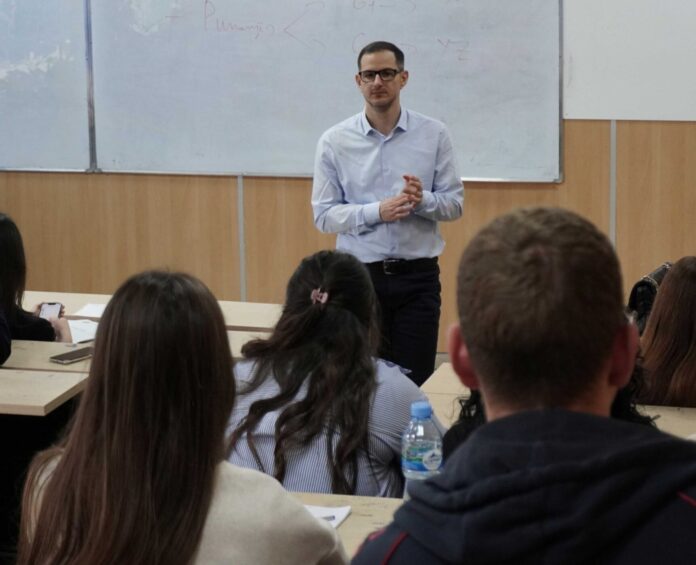
One such experience is that of Ernil Sabaj, Assistant Professor at the University of Warwick in the United Kingdom, who worked with the Faculty of Economics at the University of Tirana to review and develop the Environmental Economics course. In collaboration with Dr Ledjon Shahini, he introduced empirical studies, international data and approaches that help students connect economic theory with concrete environmental challenges, public policy and innovation.
His involvement was not limited to the lectures delivered in the classroom. Exchanges with colleagues at the University of Warwick paved the way for further academic discussions and initiatives, including opportunities for joint teaching and research. It is precisely this continuity that makes collaboration with the diaspora more than a temporary exchange of experience.
In this interview, Sabaj discusses his involvement in the Diaspora4Innovation programme, his experience of the collaboration, how Albanian students’ education can be enriched, and the importance of ensuring that links between academics in Albania and those in the diaspora do not remain isolated initiatives, but continue beyond a single project.
Through a series of interviews, Gazeta Diaspora Shqiptare will profile Albanian academics involved in Diaspora4Innovation, a programme implemented by GERMIN with the support of EU4Innovation, exploring their professional journeys, international experiences and the contributions they can make to the development of education and scientific research in Albania.
How did your journey into economics begin, and what subsequently led you towards academia and research? When did you realise that this was the professional path you wanted to pursue?
I began my studies in Economics at the University of Tirana, where I later completed a master’s degree in European Economic Studies. Alongside part-time teaching, I worked as an economist in the Macroeconomics Department at the Ministry of Finance. This gave me the opportunity to engage in economic analysis within a public institution while maintaining my connection with the university.
I subsequently completed an international Erasmus Mundus master’s degree and pursued a PhD in Economics at the University of Exeter, where I focused on macroeconomics. In 2021, I began working in the Department of Economics at the University of Warwick as a Teaching Fellow, continuing my involvement in teaching and research.
What attracts me to economics are questions directly related to people’s lives: why prices change, what affects employment, and how economic decisions affect households and businesses. Academia gives me the opportunity to study these questions in depth and discuss them with students. This combination of research and teaching drew me towards this professional path.
You are now an Assistant Professor at the University of Warwick. What does it mean to you to work and conduct research at a university with such a strong international profile? And what have been some of the most important milestones that brought you to this point?
I currently work as an Assistant Professor (Teaching Focused) in macroeconomics in the Department of Economics at the University of Warwick. It is a wonderful experience to work with economists who have made significant academic contributions and to have the opportunity to discuss my ideas with them. I particularly value what I learn from the way they approach research questions and from their feedback on my work.
My education in Tirana, my Erasmus Mundus master’s degree and my PhD at Exeter have given me experience in different academic environments. At Warwick, where I work with many international students, this helps me understand their learning styles and their expectations of their lecturers. My experience as an economist at the Ministry of Finance has also helped me gain a closer understanding of how economic policy is implemented in practice.
My position has a particular focus on teaching. Alongside research papers, I am interested in how I explain concepts to students and how I help them work independently on their own research questions. I try to bring into the classroom what I learn through research and discussions with colleagues.
Your work is related to macroeconomics and international economics. Which economic issues interest you most in your research, and how has your academic focus evolved over the years?
My research focuses on fiscal and monetary policy and on how their effects depend on economic conditions. For example, I am interested in whether an increase in public spending has the same impact when inflation is low as when it is high, or how the transmission of monetary policy changes when firms and households face financial constraints.
I also study differences between sectors: how wages and prices adjust, how workers move between sectors, and what these differences imply for the economy’s response to shocks. I use macroeconomic models and data analysis to investigate these questions.
Over time, I have become increasingly interested in the interaction between environmental economics and macroeconomics. What encourages or prevents firms from making green investments and adopting cleaner technologies? Here, I am interested in the role of financing, workers’ skills and uncertainty about the future, as well as how environmental policies interact with macroeconomic conditions. I also examine how firms’ decisions affect the wider economy in terms of output, employment and productivity.
My interests also include the relationship between climate risks and public debt sustainability. This is a perspective I wanted to bring into the Environmental Economics course as well, addressing environmental issues alongside decisions about production, investment and financing.
 Let us talk about Diaspora4Innovation. What attracted you to the programme, and what made you think it offered a concrete opportunity to bring your academic experience to Albania?
I was attracted by the fact that the programme offered a concrete way to work with colleagues in Albania. Through GERMIN’s Diaspora4Innovation programme, I collaborated with Ledjon Shahini and colleagues at the Faculty of Economics of the University of Tirana on a course where my teaching and research experience could be useful.
I studied and taught at that faculty, so returning there also had personal significance. Although I work abroad, I want to remain connected to Albania, actively contributing to its academic life and working with colleagues and students there.
I do not see this involvement simply as transferring experience from abroad. I also have things to learn from colleagues in Tirana, who know the students and the course requirements well. By working together, we can adapt each person’s experience to what is needed in the classroom.
In collaboration with Dr Ledjon Shahini, you reviewed and co-developed the Environmental Economics course. What exactly did you change, and which new topics or approaches did you consider most important for Albanian students?
Ledjon Shahini and I worked to improve the existing Environmental Economics curriculum by adding topics of interest to students, empirical studies and a broader European perspective. We expanded the coverage of carbon pricing and emissions trading, as well as their relationship with investment and innovation. We also incorporated materials on the circular, green and blue economies, linking them to issues of economic development.
We tried to explore these topics in greater detail, focusing on data and research findings, as I also do at Warwick. We used graphs and European and Albanian examples to discuss what the results showed and how they could be interpreted in the context of Albania.
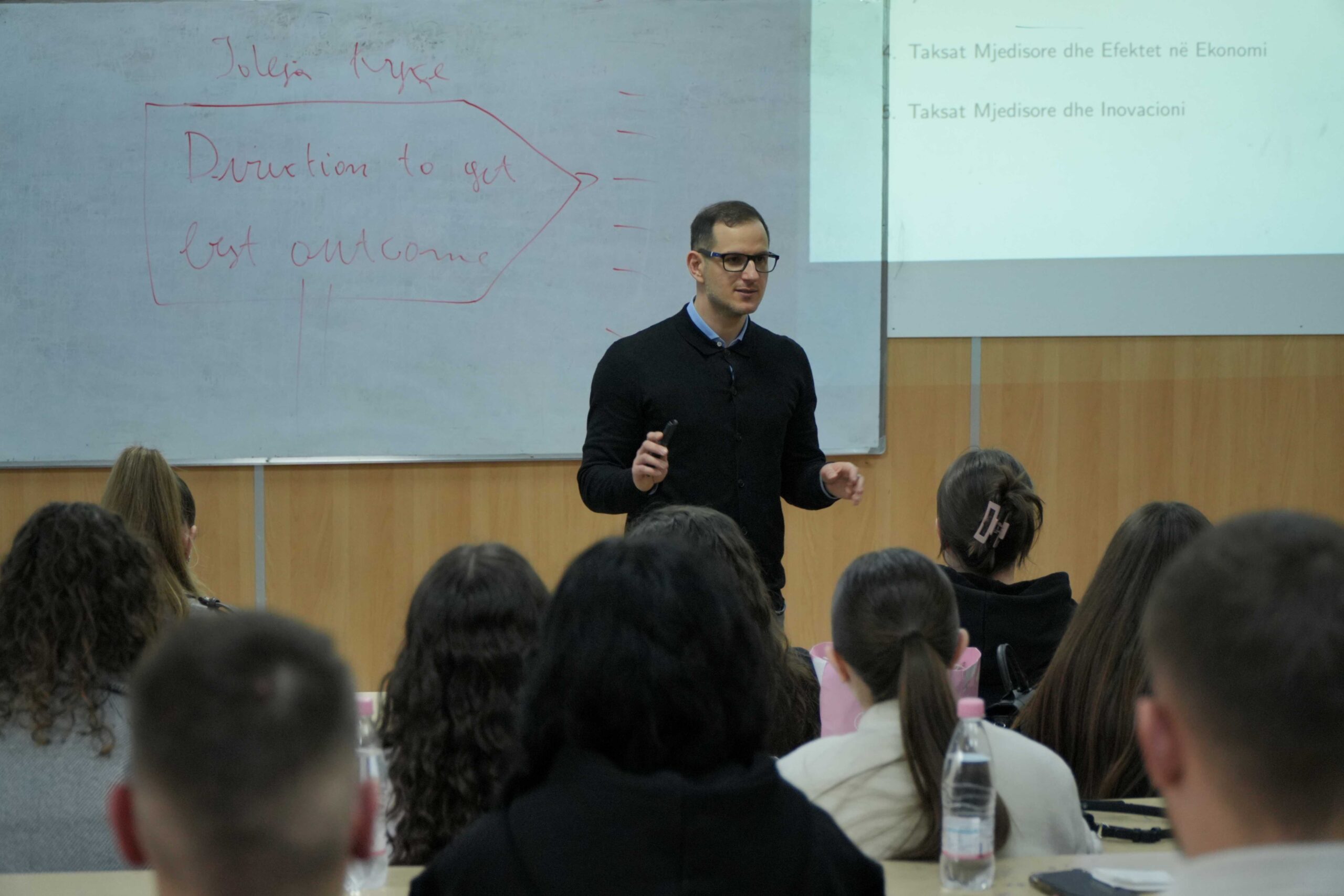
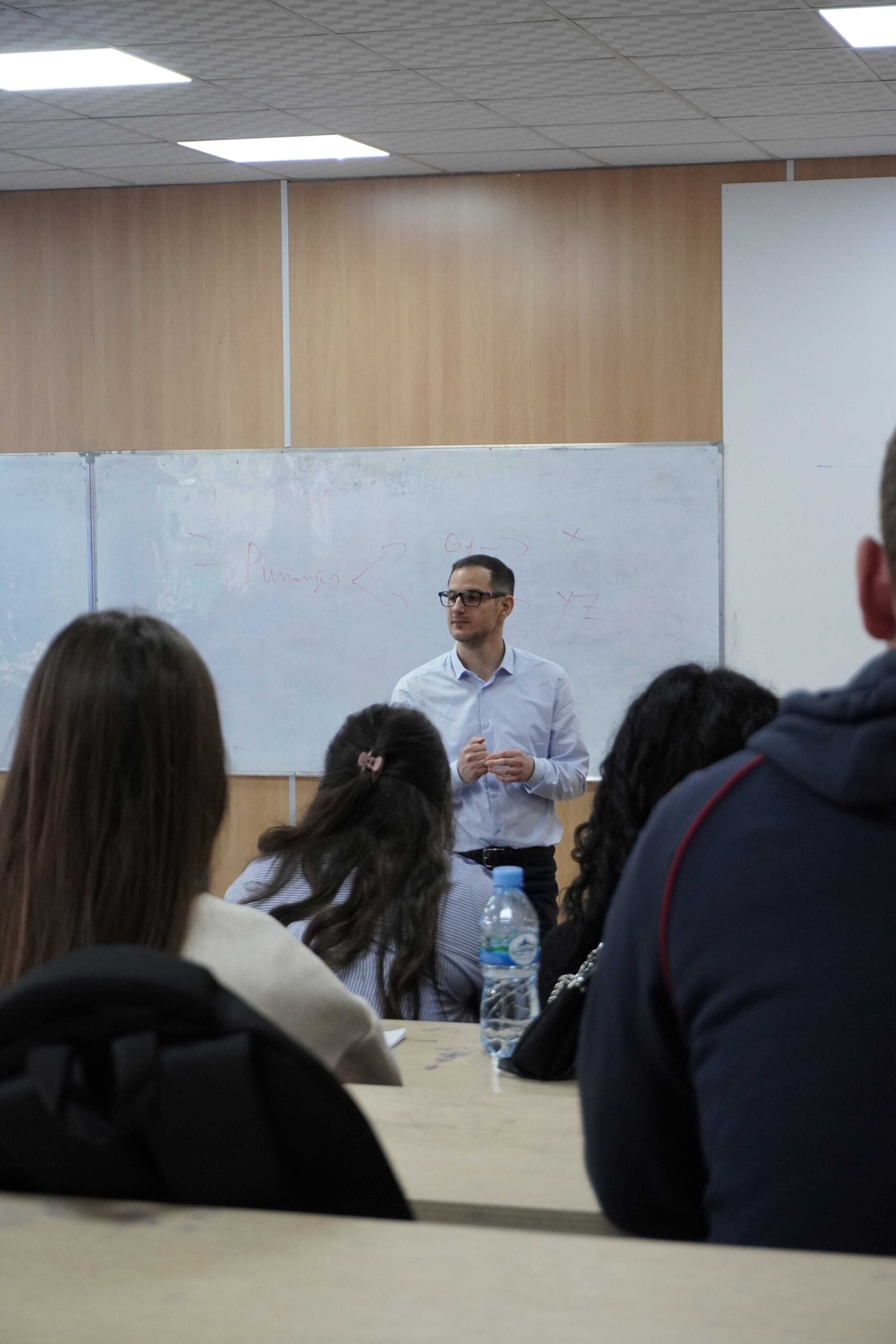
Between March and May 2025, I delivered three lectures covering environmental taxes; property rights and tradable pollution permits; and the relationship between the environment and development, including the circular, green and blue economies. We also prepared presentations and summaries in Albanian so that students could revisit the topics after the lectures.
We wanted students to understand the practical application of the subject and think beyond the core textbook. How can an environmental problem be turned into a research question, an idea for innovation or a business opportunity? Our aim was to encourage them to use the knowledge they had acquired to think about new solutions and the contribution they could make to the Albanian economy.
The programme included topics such as carbon pricing, emissions trading systems and the circular economy. Why are these concepts important for economics students today, and how applicable are they in the Albanian context?
I see these topics as part of preparing students for the economy of the future. I want them to be able to analyse changes in technology and resource use, whether they work as economists or entrepreneurs.
In our lectures, we used carbon pricing and emissions trading to examine firms’ incentives and costs. In discussing the circular economy, we explored how products and materials are designed, used, repaired and reused. We connected these topics to decisions about technology, investment and business organisation.
In Albania, I would like this knowledge to become part of students’ education at an earlier stage and to influence how they think about business. The earlier we understand these processes, the better prepared we can be to support the transition towards cleaner technologies and more efficient resource use. I would also like this education to contribute to accelerating the transition of the Albanian economy.
A student who may launch a start-up in the future needs to understand what problem their idea solves, how much it costs to implement and what technology it requires. It is equally important to know how to measure the results. This enables them to assess opportunities and risks before making a decision, rather than relying simply on the label “green”.
An interesting part of the project was the use of real data from EU institutions and international organisations. What did you want students to learn through this exercise: to understand theory better, or to learn how economics can be used to analyse concrete public policy problems?
We wanted to connect the two and also introduce students to scientific research. I did not want to present them with data alongside a ready-made interpretation. They had to try to interpret the data themselves and consider what new questions they could raise based on it.
We used sources such as Eurostat, the OECD, the World Bank and the IMF, alongside Albanian sources. In the lectures, for example, we presented data on carbon prices, revenues from environmental taxes and material use.
I wanted students to ask what an indicator measures, where the data comes from and whether the comparison we are making is appropriate. Is a graph alone enough to support our conclusion? What other information do we need? They needed to distinguish an observed relationship from a causal explanation, and a measured result from a scenario generated by a model.
When it came to innovation, I wanted students to use data to identify a problem and explore a solution. A research or business idea may begin with an observation, but it must then be investigated and tested. This was the skill I wanted them to develop: using data to reason and evaluate their ideas.
During this process, was there any reaction, question or discussion from students that made you realise the practical teaching approach was working differently from a traditional course?
I found a great deal of curiosity and thirst for knowledge among the students on this course, especially when we discussed Albania and problems they recognised from everyday life. However, I noticed that some of them took what the lecturer said for granted, without always questioning the argument or interpretation.
At times, they focused on understanding the conclusion I was explaining, rather than on asking what it was based on. I wanted to help them feel free to ask for explanations, propose a different interpretation and question whether the result would also hold under different circumstances.
This is what I mean by healthy scientific scepticism: examining the source of data, the assumptions behind a theory and the evidence supporting a conclusion. It does not mean believing nothing. My own explanation must also be supported by arguments; it is not enough that I say it as a lecturer.
I saw the students’ curiosity as a good starting point for this work. I wanted to help them develop their own judgement and learn how to support it with arguments.
Another component was Ledjon Shahini’s visit to the University of Warwick, which also contributed to the further development of the curriculum at the University of Tirana. What did this visit bring, and what can an Albanian university learn from the way teaching and research are organised at a university such as Warwick?
During Ledjon Shahini’s visit to Warwick, we had the opportunity to discuss the collaboration with Bhaskar Chakravorty, Eleanya Nduka and Juliana Carneiro. They expressed their willingness to contribute to teaching in Tirana alongside me. This interest went beyond the Jean Monnet application.
The visit also included a meeting with the Head of the Department of Economics at Warwick. He spoke about his approach to leading a large department and the challenges involved in this work. We discussed what the University of Tirana, and Albanian academia more broadly, could learn from British experience in organising research and teaching.
I would like to continue this conversation by also addressing the conditions in which academic work takes place: the time and space lecturers are given to conduct research, the relationship between research and teaching, and the support provided to students in working independently.
The University of Tirana has its own resources and needs. The value of this exchange lies in understanding which practices can be adapted there and how we can support the work of our colleagues. The meetings at Warwick gave us the opportunity to discuss these issues directly.
Following this collaboration, joint teaching and research activities have been planned, and an application for a Jean Monnet Chair has also been submitted. What would you like to see endure from Diaspora4Innovation in the long term, and what would the ideal model of collaboration between Albanian academics in the diaspora and universities in Albania look like to you?
The CATCH-EU application, “Catching Up with the EU: A Development Economics Perspective for Albania”, which Ledjon Shahini and I prepared and submitted, was one of the steps in this collaboration. Through it, we aimed to expand the work initiated through Diaspora4Innovation into a broader teaching programme.
For next year, we plan to apply again with another project or prepare applications for Erasmus+ funding, with the aim of enabling more academic exchanges. We want to create further opportunities for teaching and joint research.
I would like a sustained collaboration to emerge from this programme. Teaching materials should continue to be used and updated, and colleagues who met through the project should have opportunities to work together again. Continuity should not depend solely on a single visit or application.
This requires jointly defined needs and interests, a clear division of responsibilities and institutional support. I would like Albanian academics working abroad to remain active participants in university life in Albania, working regularly with their colleagues rather than visiting only occasionally to deliver a lecture.
